Pandunia
sal, dunia! – Hello, world!
Welcome to learn about Pandunia, an interesting constructed language.
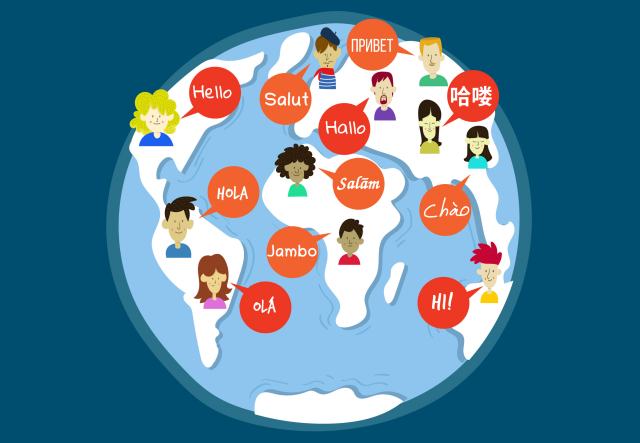
Image designed by Freepik
New version
Contents of this website are currently changing, because a new version of Pandunia is in the making.
What is Pandunia?
Pandunia is a multicultural constructed language that is spoken by a small number of people currently. It is not an international auxiliary language – yet! – because there are not enough speakers to qualify it as one.
Pandunia can be used for:
- getting to know multicultural international words
- learning scientific vocabulary
- talking with a small group of like-minded people
- challenging your mind
- creating art, like poetry and music
- fun and personal things, like keeping a diary
- dreaming of a better world, where all people are equal
All words in Pandunia are international in some part of the world. They come from widely spoken languages, including English, French, Spanish, Japanese, Chinese, Russian, Arabic, Hindi and Swahili, only to mention a few.
Pandunia is regular and simple. Therefore it can be learned much easier and faster than English and other national languages. There aren't any grammatical exceptions or complex rules in Pandunia. Pandunia is so simple that its basic grammar can be described in only ten rules. Everybody can learn Pandunia to a good level in a short period of time! Pandunia would be an excellent choice for the global second language because it could improve the quality of international communication.
Overview of Pandunia's structure
Pandunia is written in the Latin (and English!) alphabet:
A B C D E F G H I J K L M N O P R S T U V X Y Z
All letters are pronounced roughly in the same way as in English.
All vowels are pure vowels. They are pronounced as in are there three or two.
The spelling of Pandunia is nearly phonetic. One sound = one letter or a pair of letters.
The stress is on that syllable that is before the last consonant of the root word.
Prefixes and suffixes are either unstressed or they may carry a secondary stress.
múlti hóm póte bása pandúnia.
– Many people can speak Pandunia.
Words stay always the same in Pandunia. There aren't any special inflected forms for cases, tenses, moods, singular and plural etc.
The normal word order is subject–verb–object
so the doer comes first, then the action word and finally the object of the action.
mi ame tu.
– I love you.

The word order is the same also in questions.
tu ame ke?
– Who do you love?
tu ame mi, he?
– Do you love me? (i.e. Do you love, eh?)
Singular and plural are indicated with number words.
buk
– one or more books
un buk
– (one) book
du buk
– two books
tri buk
– three books
multi buk
– many books
Comparison is done with helping words: max – more; min – less; ka – than; and par – as, same, equally.
mi es max hao ka tu.
– I am better (more good) than you.
ne, tu es par hao ka mi.
– No, you are as good as me.
ho loge max rapid ka tu.
– He or she talks faster (more fast) than you.
Time is expressed with auxiliary verbs:
pas
– past events
fu
– future events
ha
– past events that are still relevant
zai
– ongoing events
homen pas lese mi su buk.
– They read my book.
mimen ha lese multi buk.
– We have read many books.
mi zai lese un buk.
– I am reading one book.
tu fu basa Pandunia.
– You will talk Pandunia.
Sentence-final particles express why the sentence is said,
i.e. is the sentence, for example, a statement, a question or a command.
tu ame kafe, he?
– You love coffee, eh? (question)
tu ame kafe, ya.
– You love coffee, indeed. (statement)
tu ame kafe, ne?
– You love coffee, don't you? (need for response)
Use it!
As you can see, it's easy for everyone to learn the basics of Pandunia, and it's even easier for those who speak some English! It's also easy to start using the language immediately. So don't wait! Use it with your friends in everyday life or try it with strangers when you are traveling. It works!
You can find other Pandunia speakers in the internet in following forums.
- Our own discussion forum – login not required!
- Pandunia Discord server
- Forum in Reddit
- Pandunia Facebook group
- Multilingual channel and Pandunia-only channel in Telegram
- QQ channel number 717549404 for discussion in Chinese
Find Pandunia speakers near you in Amikumu app!
More stuff
- Complete grammar of Pandunia in PDF format
- Searchable dictionary
- Origins of words
- Go to the Pandunia lexe na dunia karta pages to see where every Pandunia word is from on a world map.
- Stories in Pandunia
- Counting in Pandunia in Of Languages and Numbers

Image designed by Freepik
You can contact the creator and a main developer of Pandunia, Risto Kupsala, via email risto@pandunia.info and in the aforementioned forums.
pandunia

ze hol dunia, do hol dunia
– from the whole world, for the whole world